





 服务商工作站 >>





细胞稳转株构建
云舟生物提供高性价比且短周期的细胞稳转株构建服务。我们的技术团队拥有资深经验,可为您量身定做个性化基因修饰的细胞株。根据实验目的、修饰位点和细胞株,我们可采用化学转染、电转染或者病毒转导的方法引入所需的DNA修饰。标准药筛过后,多克隆细胞群或者单克隆细胞株经传代、验证并交付您使用。所有使用细胞株均保证携带理想的基因型,无污染且经ATCC标准认证。
服务详情


细胞稳转株的构建流程

文档
使用说明书
关于更多类型细胞株的使用方法,请参照ATCC或中国科学院细胞库提供的细胞信息。
精选文献
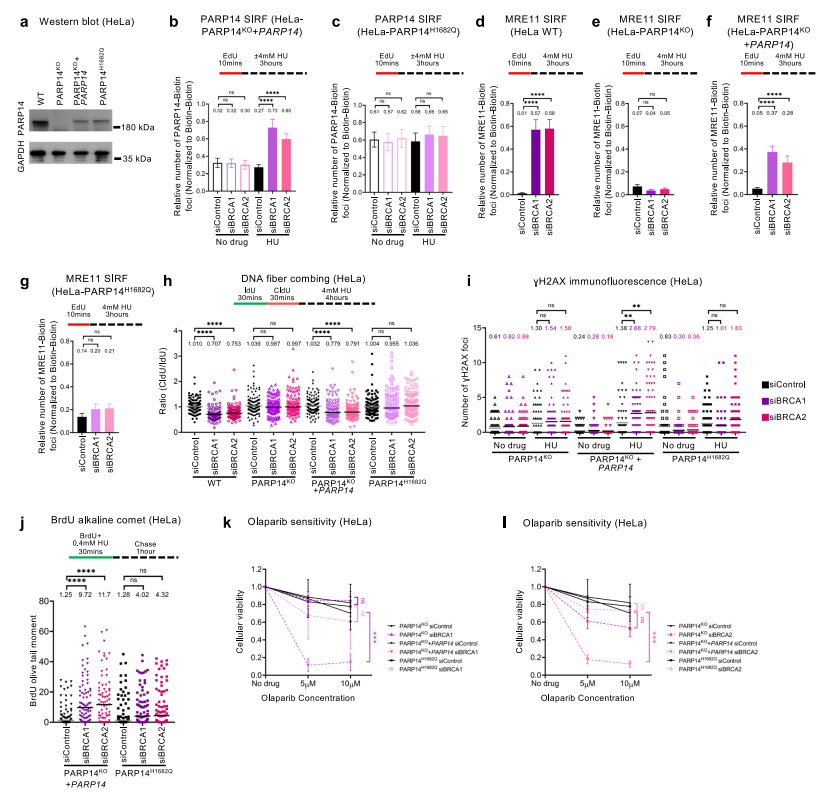
The KU-PARP14 axis differentially regulates DNA resection at stalled replication forks by MRE11 and EXO1
Ashna Dhoonmoon, Claudia M. Nicolae & George-Lucian Moldovan.
Nature Communications, 2022, doi: 10.1038/s41467-022-32756-5
使用的云舟生物产品或服务Abstract: Suppression of nascent DNA degradation has emerged as an essential role of the BRCA pathway in genome protection.In BRCA-deficient cells, the MRE11 nuclease is responsible for both resection of reversed replication forks, and accumulation of single stranded DNA gaps behind forks. Here, we show that the mono-ADP-ribosyltransferase PARP14 is a critical co-factor of MRE11. PARP14 is recruited to nascent DNA upon replication stress in BRCA-deficient cells, and through its catalytic activity, mediates the engagement of MRE11. Loss or inhibition of PARP14 suppresses MRE11-mediated fork degradation and gap accumulation, and promotes genome stability and chemoresistance of BRCA-deficient cells. Moreover, we show that the KU complex binds reversed forks and protects them against EXO1-catalyzed degradation. KU recruits the PARP14-MRE11 complex, which initiates partial resection to release KU and allow long-range resection by EXO1. Our work identifies a multistep process of nascent DNA processing at stalled replication forks in BRCA-deficient cells.
>展开<收起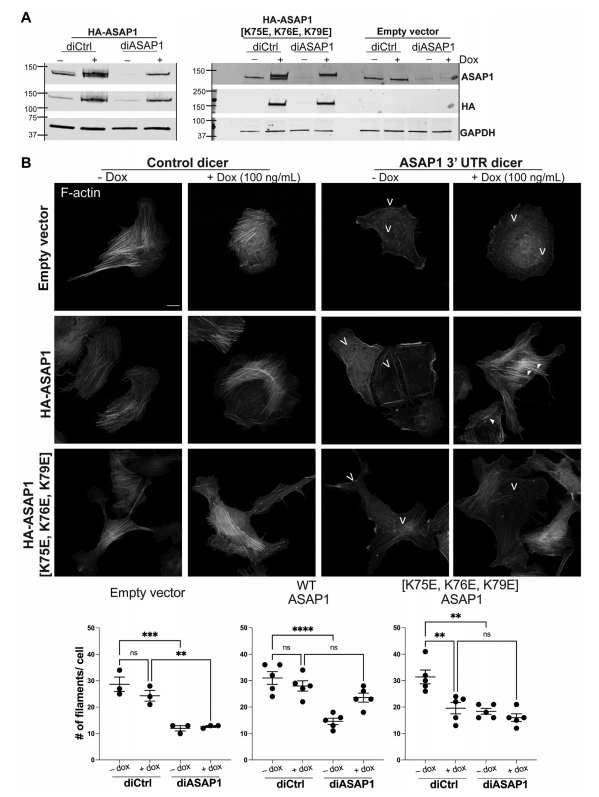
A lysine-rich cluster in the N-BAR domain of ARF GTPase-activating protein ASAP1 is necessary for binding and bundling actin filaments
Anjelika Gasilina, et al.
Journal of Biological Chemistry, 2022, doi: 10.1016/j.jbc.2022.101700
使用的云舟生物产品或服务Abstract: Actin filament maintenance is critical for both normal cell homeostasis and events associated with malignant transformation. The ADP-ribosylation factor GTPase-activating protein ASAP1 regulates the dynamics of filamentous actin_x0002_based structures, including stress fibers, focal adhesions, and circular dorsal ruffles. Here, we have examined the molecular basis for ASAP1 association with actin. Using a combination of structural modeling, mutagenesis, and in vitro and cell-based assays, we identify a putative-binding interface between the N-Bin-Amphiphysin-Rvs (BAR) domain of ASAP1 and actin filaments. We found that neutralization of charges and charge reversal at positions 75, 76, and 79 of ASAP1 reduced the binding of ASAP1 BAR-pleckstrin homology tandem to actin filaments and abrogated actin bundle formation in vitro. In addition, overexpression of actin-binding defective ASAP1 BAR-pleckstrin homology [K75, K76, K79] mutants prevented cellular actin remodeling in U2OS cells. Exogenous expression of [K75E, K76E, K79E] mutant of full-length ASAP1 did not rescue the reduction of cellular actin fibers consequent to knockdown of endogenous ASAP1. Taken together, our results support the hypothesis that the lysine-rich cluster in the N-BAR domain of ASAP1 is important for regulating actin filament organization.
>展开<收起